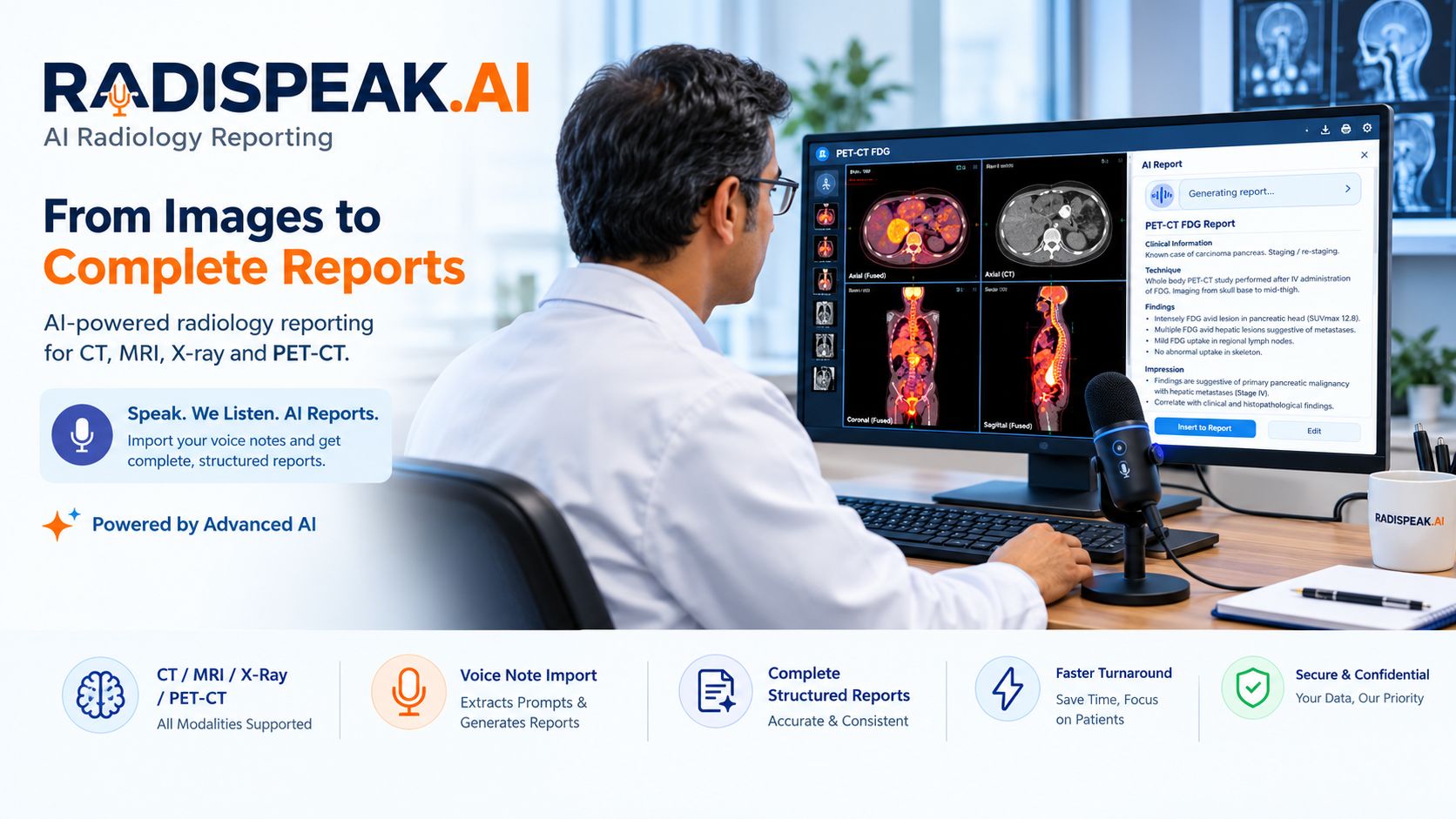
PET-CT FDG studies combine metabolic information from PET with detailed anatomical information from CT, making them an important imaging modality for oncology and several other clinical applications. However, interpreting and documenting PET-CT findings can be a detailed and time-consuming reporting process.
RADISPEAK.AI brings AI-assisted reporting into this workflow, helping radiologists convert their observations and clinical inputs into complete, structured PET-CT FDG reports.
From PET-CT Findings to a Complete Report
A PET-CT report generally requires correlation of multiple components, including:
- Clinical history and indication
- FDG distribution and metabolic activity
- SUV measurements where relevant
- Anatomical findings on CT
- Focal areas of abnormal uptake
- Lymph nodes and distant lesions
- Comparison with previous studies
- Treatment response or disease progression
- Overall impression
RADISPEAK.AI is designed to help organize these inputs into a coherent reporting format.
Voice-Enabled AI Reporting
One of the key features of RADISPEAK.AI is its voice-note workflow.
Instead of typing every observation, the radiologist can dictate findings and relevant reporting instructions. The AI processes the spoken input and assists in creating a structured report.
For example, a radiologist can provide:
Test Description:
PET-CT FDG Whole Body
followed by clinical history, observations, measurements and findings.
RADISPEAK.AI can then use these inputs to generate a complete report that the radiologist can review, edit and finalize.
PET and CT Correlation
PET-CT interpretation requires correlation between metabolic activity and anatomical structures. AI-assisted reporting can help organize observations such as:
- Hypermetabolic lesions
- SUV values
- Primary tumour sites
- FDG-avid lymph nodes
- Hepatic, pulmonary or osseous lesions
- Physiological FDG uptake
- Treatment-related changes
- Interval changes compared with prior examinations
The generated report remains subject to radiologist review and clinical judgment.
Structured Reporting for Consistency
A structured approach can make PET-CT reports easier to read and clinically useful. RADISPEAK.AI can assist with organizing information into sections such as:
Clinical Information
Technique
Findings
PET Findings
CT Findings
Comparison
Impression
This helps reduce the need to manually construct the report format for every study.
AI-Assisted, Not AI-Replaced
RADISPEAK.AI is designed as a reporting assistance tool for radiologists, not as a replacement for professional interpretation.
The radiologist remains responsible for reviewing the imaging, validating the findings, making the clinical interpretation and approving the final report.
The objective is simple:
Let the radiologist focus on interpretation while AI assists with the reporting workflow.
Beyond PET-CT
Although PET-CT reporting can involve particularly complex information, the RADISPEAK.AI workflow is designed for multiple imaging modalities, including:
CT • MRI • X-ray • PET-CT
With voice-note input and AI-assisted report generation, the platform can help radiologists move from their observations to a structured report more efficiently.
RADISPEAK.AI — Speak. We Listen. AI Reports.
AI-assisted radiology reporting designed to help transform radiologist inputs into complete, structured reports.
Experience AI-Assisted PET-CT Reporting with RADISPEAK.AI
Make your PET-CT FDG reporting workflow more efficient with AI-assisted report generation, voice-note input and structured reporting.
Speak. We Listen. AI Reports.
📞 Call / WhatsApp: +91-9350845734
📧 Email: info@radispeak.ai
🌐 Web: radispeak.ai
Contact the RADISPEAK.AI team to learn more or request a demonstration.